
Forex trading has never been more accessible. You can open an account in minutes, deposit from your phone, and start practicing on a demo the same afternoon. The flip side is that accessibility also lowers the barrier for people who rush in without preparation and lose money they could not afford to lose. Safe trading is not about being timid. It is about building the right habits from the start so your account survives long enough for you to actually develop skill. This guide covers what that looks like in practice.
Pick a Broker You Can Trust
This step comes before everything else because all the good habits in the world do not help if you are trading with a broker that manipulates prices, delays withdrawals, or disappears with client funds. It sounds extreme, but the retail forex space attracts plenty of questionable operations alongside the legitimate ones.
The benchmark is straightforward: choose a broker regulated by a recognized authority. CySEC in Cyprus, ASIC in Australia, and the FCA in the UK are the most established regulators for retail forex brokers. They require segregated client accounts, regular audits, negative balance protection, and a formal complaints process. Traders registered under these entities have real recourse if something goes wrong.
An online Forex trading platform from a broker operating since 2005 with over 500,000 clients worldwide, offices across multiple countries, and CySEC oversight represents a very different risk profile from a six-month-old offshore entity offering implausible returns. Longevity and regulatory status matter.
Practical checks: can you find clear information about the broker’s licenses? Are withdrawals processed reliably based on independent reviews? Is customer support reachable and responsive? A broker that passes those three checks is worth considering. One that fails any of them is not.
Use a Demo Account Before Risking Real Money
A demo account gives you a fully functional trading environment with virtual funds. Every serious broker offers one for free. The advice to use it is almost universal, and almost universally ignored by beginners who are impatient to make real money.
Here is why it matters. The early weeks of trading are when you make the most mistakes. You click the wrong button and open a position in the wrong direction. You forget to set a stop-loss. You close a profitable trade too early because you got nervous. You hold a losing trade too long because you convinced yourself it would reverse. All of these mistakes cost money on a live account and nothing on demo.
Spend at least two to four weeks on demo before depositing. Use that time to learn the platform mechanics thoroughly, test a basic strategy over 30 to 50 trades, and practice placing stop-losses and calculating position sizes before every entry. When those habits feel automatic, you are ready to go live.
Understand What You Are Actually Trading
Currency pairs are the core product. EUR/USD, GBP/USD, USD/JPY, and the other major pairs involving the US dollar make up the most liquid and heavily traded instruments in the market. For a beginner, starting with one of these, most commonly EUR/USD because of its tight spreads and abundant analysis, is the sensible choice.
Each currency pair has a price, a spread, and a daily range. The spread is what you pay to enter a trade: the difference between the buy price and the sell price. On ECN accounts, raw spreads can start from 0.0 pips with a small commission per lot. On Classic accounts, the spread is wider but there is no separate commission, which makes the cost structure easier to understand at first.
Leverage amplifies both gains and losses. With 1:100 leverage, a $1,000 deposit controls a $100,000 position. A 1% move in your favor means $1,000 profit. A 1% move against you means $1,000 loss, which is your entire deposit. New traders should use far less leverage than the maximum available. Effective leverage of 5:1 to 10:1 leaves room to absorb normal market noise without wiping an account on a single bad trade.
Build Your Risk Management Rules Before Your First Trade
Risk management is not a topic you learn after you start trading. It is a set of rules you establish before your first real trade and follow without exception. Traders who skip this step are not trading: they are taking unstructured positions with unpredictable outcomes.
The core rules are simple. Risk no more than 1-2% of your account balance on any single trade. Before you open a position, calculate where the stop-loss goes and how large the position needs to be so that the stop represents 1-2% of the account. Only then open the trade. This calculation takes 30 seconds and makes position sizing a mechanical process rather than a gut feeling.
The table below shows how account balance, risk percentage, and stop-loss distance combine to determine position size:
| Account balance | Risk per trade | Stop-loss distance | Max position size |
| $500 | 1% ($5) | 20 pips | 0.025 lots |
| $1,000 | 1% ($10) | 30 pips | 0.033 lots |
| $1,000 | 2% ($20) | 30 pips | 0.066 lots |
| $5,000 | 1% ($50) | 25 pips | 0.20 lots |
The numbers are approximate and vary by pair and pip value, but the structure is universal. Risk is defined before the trade, not after.
Stay Away From These Common Traps
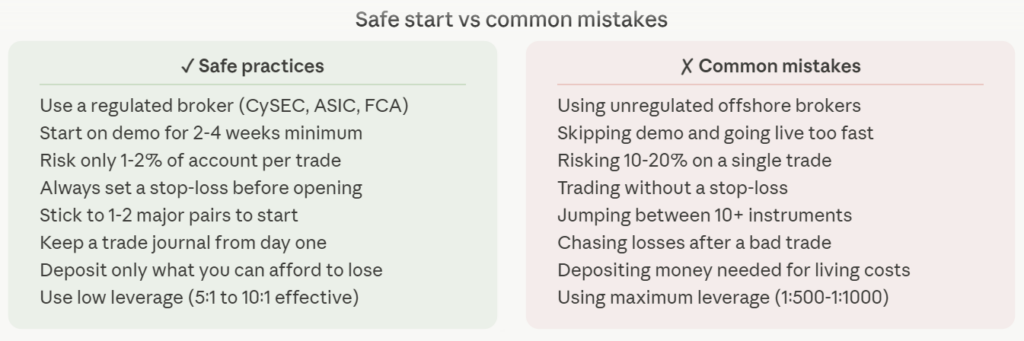
A few patterns appear consistently in the accounts of traders who blow up early. Knowing them in advance does not guarantee you will avoid them, but it makes you more likely to catch yourself.
Revenge trading happens after a loss. The instinct is to immediately open another trade to win the money back. The result is usually a second loss, because the decision is driven by emotion rather than a genuine setup. The rule: after two consecutive losses in a session, close the platform and come back the next day.
Overtrading is the compulsion to always be in a position. Markets spend a lot of time in choppy, directionless conditions where the edge in most strategies disappears. The correct response is to do nothing and wait for the conditions that match your setup. Beginners find this hard because it feels passive. Experienced traders find it easy because they have learned that protecting capital in bad conditions is as important as making money in good ones.
Holding losing trades past the stop-loss because of hope that the market will reverse is probably the single most destructive habit in retail forex. Once you have placed a stop-loss level based on your analysis, the stop is not optional. Moving it further away or removing it entirely because the trade is underwater transforms a controlled loss into a potentially account-ending one.
Conclusion
Trading forex safely in 2026 starts with three things: a regulated broker, time spent on demo, and risk management rules applied before the first real trade. The market itself is not the main risk for most beginners. Their own behavior is. Getting into bad habits early is easy and expensive to undo. Building the right habits from the start takes a few extra weeks but sets you up for a trading career that can actually develop over time. Take the demo seriously, keep leverage low, and let the account survive long enough for skill to follow.

Aisha Noreen is an owner of a small business with more than 9 years of experience in the marketing industry. With the wisdom of an old soul, she always seeks innovation and mind-blowing ROI techniques. Her unique approach helped many small businesses thrive and she can surprise you in many ways as well. Believe it or not, her energy, passion, and creativity are contagious enough to transform your business and take it to another level.