
Conventional top-down performance reviews provide narrow scopes and usually lack critical information exchanged among peers, direct reports, and other collaborators. 360 reviews invite multi-directional feedback and provide a complete performance picture necessary in the context of the modern-day workplaces that focus on collaboration, agility, and continuous improvement. It is essential to know how a 360 review works and its importance to realise why progressive organisations are using the tool to develop talents and improve their cultures.
Defining 360 Review Process
In 360-degree feedback, the supervisors, peers, direct reports and in some cases, customers or external partners provide anonymous feedback. Contrary to annual reviews of managers whose main emphasis is on performance, 360 reviews determine behavioral capabilities- leadership, communication, collaboration, strategic thinking, adaptability. Behavioral anchors and rating scales of structured questionnaires provide consistency within the raters. Self-assessments give further insight into gaps in perception between the way leaders perceive themselves and how they are perceived by stakeholders.
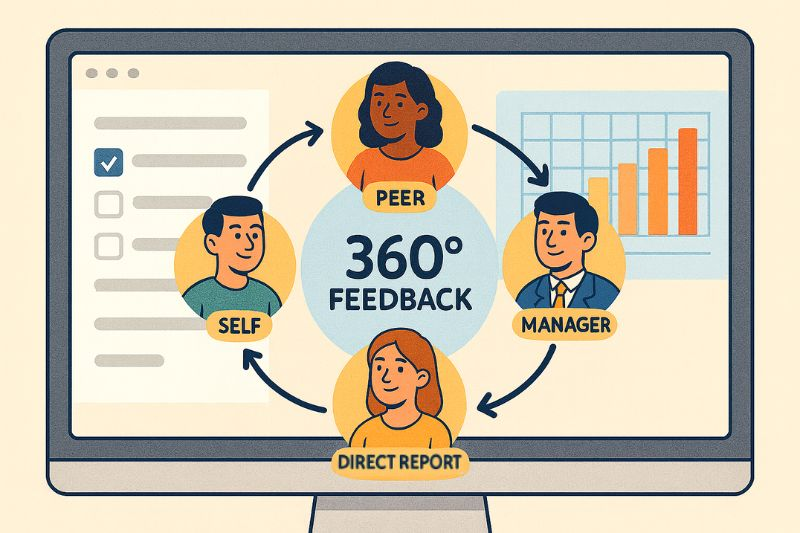
The common raters used in 360 review processes include 8-12 different raters with different relationship in the workplace. HR aids in the collection that is anonymous, aggregation of data, and provides de-identified reports to participants. Follow-up coaching sessions can be used to convert insights into practical development programs to bridge the competency gaps.
Organizational Level Benefits
The executives develop vital blind-spot recognition such as the spheres of leadership style compromising strategic implementation in spite of excellent performance. Direct report feedback is provided to managers indicating the level of team morale affected by a communication pattern or decision making process. Individual donors get the benefit of peer insights into the areas of collaboration that are doing well or silos that are impeding the effectivity of cross-functional collaboration. The organizational culture is enhanced by the use of regular behavioral messages on the importance of competencies that are appreciated.
Improving Self-Knowledge and Growth

Most leaders have exaggerated strengths and underrated weaknesses, the 360 feedback addresses the gaps between perceptions and reality with solid multi-perspective information. The identification of behavioral patterns hastens the focused development – public speaking training of executives, delegation training of micromanagers, strategic communication training of tactical thinkers. Measurable improvement in performance is an indicator of ROI on investments in leadership development.
Driving Cultural Alignment
The 360 processes strengthen organizational values that instill the intended practices in performance dialogue. Regular communication among levels forms behavioral patterns of strategic interests. Through multi-rater validation of leadership-readiness that is not limited to manager recommendations, high-potential talent identification speeds up.
Best practices of implementation.
Design and implementation of processes are the key to success. Clear communication has solutions to the problem of anonymity and developmental rather than evaluative focus. Consistent behavioral interpretation is achieved by rater calibration sessions. Sensitive feedback debriefing is done constructively by competent facilitators. Post-review development plans consist of actionable development plans with timelines and metrics to maintain momentum.
Technology-Enabled Efficiency
Current systems facilitate the faceless gathering, computerized examination, and longitudinal pattern. Thematic analysis through AI brings out behavioral patterns across departments. The results are put into perspective by making benchmarks with the industry standard. Connection to performance management systems develops integrated ecosystems of talent development.
The possible Likely Problems and Remedies
Rater reluctance compromises the quality of data. Training negates hesitation and puts developmental purpose on the forefront. Inflation rating is a misleading phenomenon–curves of forced distribution are honest. The time spend issues that were addressed using mobile-optimised short-form surveys. The cultural resistance was defeated by means of executive and early-win model.
Impact measurement on an Organization.
Surveys in this area indicate that cultures are improved after implementation. The effectiveness of development is proven by the promotion rates of 360 participants. Bench depth is confirmed by leadership pipeline strength metrics which track the maturity of the 360 process tracked by participation rates in the rater and completion of the action plan.
Future Evolution Trends
Combination with real time feedback systems establishes live 360 feedback. AI-based behavioral nudges present timely development cues. A cross-organizational benchmarking increases the value of external perspective. Gamification increases the interaction of raters and allows anonymity.
The 360 reviews make talent management an annual rite instead of an engine of constant development. The multi-perspective thoughts lead to behavioral change that establishes high-performance cultures in which leadership excellence is an organizational reality rather than an anomaly.

Tim Kelly, J.D., is a legal writer for LawInfo.com. He holds a law degree from Mitchell Hamline School of Law in St. Paul, Minnesota. Tim has a background in retail copywriting and entertainment journalism, with his work being featured in various publications, including the New York Times and EW.com. In 2017, he transitioned into the legal industry, specializing in intellectual property and small business law. Tim resides in the Twin Cities and takes great joy in being a husband, father, and passionate record collector.